LINK
“Someday financial markets will decline...rising stock/bond markets will no longer be government policy. QE will end and money won’t be free. Corporate failure will be permitted. The economy will turn. Someday, somewhere, somehow, investors will lose money and once again come to favor capital preservation over speculation. Someday, interest rates will be higher, bond prices lower, and the prospective return from owning fixed-income instruments will again be commensurate with risk.” Seth Klarman
Saturday, August 29, 2015
Thursday, August 27, 2015
Real Estate Crash: Small Losers, Bigger Losers
By
Harry S. Dent Jr., Senior Editor, Economy
& Markets
"I like to practice what I preach. I don’t own my home. I rent.
I’ve been renting my house in Tampa since October 2005, because I’ve seen what’s coming – the bursting of the greatest real estate bubble in modern history.
I don’t want to get caught up in the storm when it hits… and I don’t want you to either.
That’s why I’ve been saying you should sell all non-essential real estate as this bubble has rekindled – and hence, is in danger of bursting again.
I realize that’s not an easy decision to make. I can talk people out of stocks, but real estate is a more emotional issue.
You might have grown up in that house. Plan to retire – even die – there. Or just plain not want to move!
But the fact is, when real estate starts to fall, it can become very illiquid. Once the market realizes that there’s far more supply than there ever will be demand, selling your home for what you consider a reasonable price will become damn near impossible.
If you plan to retire off your home – or your home equity holds any major part of your retirement plan – you should change your plans. Home values will only depreciate in the years to come.
However… that doesn’t mean real estate will fall the same across the board.
This is a
question I received recently: When real estate falls, will it be across the
whole market, or more specific to cities with massive real estate bubbles?
In other words: “Harry, do I really have to sell my home?”
The quick and dirty answer is – of course it will be different.
Several factors go into pricing real estate regionally. Supply and demand. Migration from other parts of the country. Immigration from around the world.
For those reasons, the major cities are naturally the most bubbly. They attract immigration from wealthy foreigners (namely the Chinese) so they can educate their kids and launder their money out of their home country.
Vancouver, Sydney, Melbourne, London and Singapore are some of the best examples internationally. In the U.S., the coastal cities tend to be the most bubbly – New York, San Francisco, L.A., Miami, D.C., San Diego, Boston and Seattle.
When the massive and unprecedented Chinese real estate bubble implodes, it will impact many of these cities most directly.
So of course the bubbliest cities will get hit the worst. The smaller and more inland cities and counties less so.
But that doesn’t mean you won’t be hit too.
Overall, our country is looking at a real estate crash of 46% or more from the bounce since 2012. If real estate falls back to its 1996 lows – my worst case scenario – we could see a loss as much as 59%.
See the chart below, which shows the potential decrease into 2017 or later. Real estate could slide back to January 2000 levels when this bubble started, or as far as to 1996 lows:

You’ll
notice this bubble had started to burst with a 34% crash during the subprime
crisis, then ticked back up when the Fed and central banks around the world
decided to inject our markets full of crack (read, quantitative easing).
So when this bubble bursts, for the final time this round, we’re looking at returning to either the 2000 or 1996 levels – 1996 being the worst scenario.
The chart below shows the range of this downside risk in 20 major cities across the U.S. based on these 1996 and 2000 prices:
You can tell that
there are huge variations in these downside risks. They range from -5% at the
2000 lows in Cleveland, all the way to -67% to the worse 1996 lows in L.A.
Tampa, where I live, has a downside risk of -37% to -45%.
Do you understand why I don’t own a home in Tampa!?
Of course, this chart doesn’t tell the whole story.
Dallas and Denver are two examples of cities that did not bubble up as much going into 2006, so they didn’t get as clobbered in the last crash.
But since then, they’ve bubbled to new heights – partly due to the fracking revolution, which is just another symptom of this artificial economy as the housing market itself!
Again, I understand real estate is an emotional issue. But I’m warning you – there will be no mercy in this upcoming global financial crisis when credit bubbles like our housing market start spontaneously combusting.
My number one rule is: the greater the bubble, the greater the burst.
My number two rule: look at what your real estate – residential or commercial – was worth when the bubble started in January 2000. If you’ve built a home since then, check your city’s averages. That best defines your downside risk in a complex real estate market across the country.
Don’t wait to see what happens first. Price your property to move. Then sell quickly...."
In other words: “Harry, do I really have to sell my home?”
The quick and dirty answer is – of course it will be different.
Several factors go into pricing real estate regionally. Supply and demand. Migration from other parts of the country. Immigration from around the world.
For those reasons, the major cities are naturally the most bubbly. They attract immigration from wealthy foreigners (namely the Chinese) so they can educate their kids and launder their money out of their home country.
Vancouver, Sydney, Melbourne, London and Singapore are some of the best examples internationally. In the U.S., the coastal cities tend to be the most bubbly – New York, San Francisco, L.A., Miami, D.C., San Diego, Boston and Seattle.
When the massive and unprecedented Chinese real estate bubble implodes, it will impact many of these cities most directly.
So of course the bubbliest cities will get hit the worst. The smaller and more inland cities and counties less so.
But that doesn’t mean you won’t be hit too.
Overall, our country is looking at a real estate crash of 46% or more from the bounce since 2012. If real estate falls back to its 1996 lows – my worst case scenario – we could see a loss as much as 59%.
See the chart below, which shows the potential decrease into 2017 or later. Real estate could slide back to January 2000 levels when this bubble started, or as far as to 1996 lows:

So when this bubble bursts, for the final time this round, we’re looking at returning to either the 2000 or 1996 levels – 1996 being the worst scenario.
The chart below shows the range of this downside risk in 20 major cities across the U.S. based on these 1996 and 2000 prices:
You can tell that
there are huge variations in these downside risks. They range from -5% at the
2000 lows in Cleveland, all the way to -67% to the worse 1996 lows in L.A.Tampa, where I live, has a downside risk of -37% to -45%.
Do you understand why I don’t own a home in Tampa!?
Of course, this chart doesn’t tell the whole story.
Dallas and Denver are two examples of cities that did not bubble up as much going into 2006, so they didn’t get as clobbered in the last crash.
But since then, they’ve bubbled to new heights – partly due to the fracking revolution, which is just another symptom of this artificial economy as the housing market itself!
Again, I understand real estate is an emotional issue. But I’m warning you – there will be no mercy in this upcoming global financial crisis when credit bubbles like our housing market start spontaneously combusting.
My number one rule is: the greater the bubble, the greater the burst.
My number two rule: look at what your real estate – residential or commercial – was worth when the bubble started in January 2000. If you’ve built a home since then, check your city’s averages. That best defines your downside risk in a complex real estate market across the country.
Don’t wait to see what happens first. Price your property to move. Then sell quickly...."
Wednesday, August 26, 2015
"Are You Ready For the Next Leg Down?"
"The
last 12 months has seen a sharp shift in tone regarding criticism of the Fed.
Up until 2014, the mainstream financial media’s view of the Fed and its
policies was that they had saved the financial system in 2008 and generated an
economic "recovery."
Anyone with a working brain knew this was bogus: you cannot solve a debt crisis by issuing more debt. But because the financial media makes its money from financial firms’ advertising Dollars, it (the media) was happy to promote the narrative that the Fed was omniscient and expertly adept at managing the economy.
Then things began to change.
First in the summer of 2014, Congress moved to introduce new oversight of the Fed’s policies, particularly regarding its control of interest rates.
Then the Fed was ensnared in a “leak” scandal indicating it had been providing insider information to key individuals before the public (the Fed has been leaking information for years... but the fact it became common knowledge was new).
And then a growing number of commentators began to point out that the Fed’s QE programs didn’t actually do anything for the general economy, but did increase wealth inequality.
It is this last item that has proven to be the most problematic for the Fed… particularly now that the markets are collapsing with interest rates already at zero.
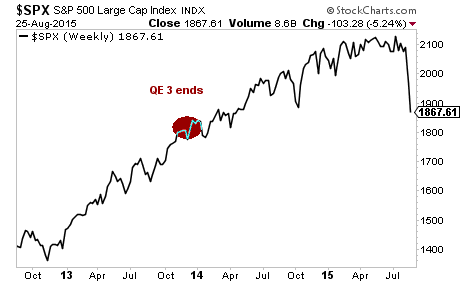
The Fed has openly stated that QE was a success because it pushed stocks higher. However, it’s hard to swallow this when stocks erase ALL of their post-QE 3 gains in a matter of four days.

In simple terms, the market collapse of the last week has proven point blank that the Fed’s theories are bogus and not based on reality. Moreover, now that the financial media has begun to promote the narrative that QE creates wealth inequality, any new QE program would be seen as a bailout of the wealthy.
This means the Fed will be unable to directly intervene to prop the markets up. We get evidence of this from the fact that NO Fed officials appeared yesterday to provide verbal intervention for the markets.
Every other time the markets has broken down in the last six years, a Fed President appeared to talk about some new policy to prop the markets up.
NOT THIS TIME. The Fed's silence signals that things have changed in a big way. Smart investors should start preparing now. This mess is not over by any stretch...."
Graham Summers
Phoenix Capital Research
Anyone with a working brain knew this was bogus: you cannot solve a debt crisis by issuing more debt. But because the financial media makes its money from financial firms’ advertising Dollars, it (the media) was happy to promote the narrative that the Fed was omniscient and expertly adept at managing the economy.
Then things began to change.
First in the summer of 2014, Congress moved to introduce new oversight of the Fed’s policies, particularly regarding its control of interest rates.
Then the Fed was ensnared in a “leak” scandal indicating it had been providing insider information to key individuals before the public (the Fed has been leaking information for years... but the fact it became common knowledge was new).
And then a growing number of commentators began to point out that the Fed’s QE programs didn’t actually do anything for the general economy, but did increase wealth inequality.
It is this last item that has proven to be the most problematic for the Fed… particularly now that the markets are collapsing with interest rates already at zero.
The Fed has openly stated that QE was a success because it pushed stocks higher. However, it’s hard to swallow this when stocks erase ALL of their post-QE 3 gains in a matter of four days.
In simple terms, the market collapse of the last week has proven point blank that the Fed’s theories are bogus and not based on reality. Moreover, now that the financial media has begun to promote the narrative that QE creates wealth inequality, any new QE program would be seen as a bailout of the wealthy.
This means the Fed will be unable to directly intervene to prop the markets up. We get evidence of this from the fact that NO Fed officials appeared yesterday to provide verbal intervention for the markets.
Every other time the markets has broken down in the last six years, a Fed President appeared to talk about some new policy to prop the markets up.
NOT THIS TIME. The Fed's silence signals that things have changed in a big way. Smart investors should start preparing now. This mess is not over by any stretch...."
Graham Summers
Phoenix Capital Research
Tuesday, August 25, 2015
"Central Banks Will Be Powerless to Stop this Crisis"
"The
financial system is in uncharted waters... and it's not clear that the Fed has
a clue how to navigate them.
A number of key data points suggest the US is entering another recession. These data points are:
1) The Empire Manufacturing Survey
2) Copper’s sharp drop in price
3) The Fed’s own GDPNow measure
4) The plunge in corporate revenues
Why does this matter? After all, the US typically enters a recession every 5-7 years or so.
This matters because interest rates are currently at zero. Never in history has the US entered a recession when rates were this low. And it spells serious trouble for the financial system going forward.
Firstly, with rates at zero, the Fed has little to no ammo to combat a contraction. Some Central Banks have recently cut rates into negative territory. However, this is politically impossible in the US, particularly with an upcoming Presidential election.
This ultimately leaves QE as the last tool in the Fed’s arsenal to address an economic contraction.
However, at $4.5 trillion, the Fed’s balance sheet is already so monstrous that it has become a systemic risk in of itself. And the Fed knows this too… Janet Yellen, before she became Fed Chair, was worried about how the Fed could safely exit its positions back when its balance sheet was only $1.3 trillion during QE 1 in 2009.
Moreover, it’s not clear that the Fed could launch another QE program at this point. For one thing there is that aforementioned upcoming Presidential election. Another QE program would just be fuel for the fire that is growing public anger with Washington’s meddling in the economy. And this would lead to greater scrutiny of the Fed and its decision making.
Even if the Fed were to launch another QE program in the next 15 months, it’s not clear how much it would accomplish. A psychological shift has hit the markets in which investors’ faith in Central Bank policy is no longer sacrosanct.
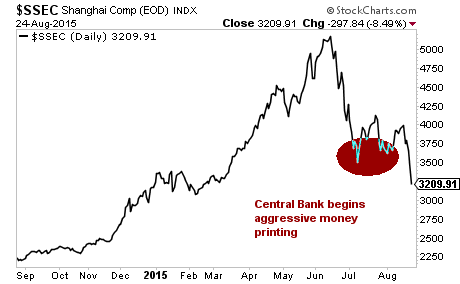
Consider China, where despite rampant money printing, the stock market has continued to implode, crashing to new lows. China’s Central Bank is pumping $29 billion into its stock markets per day. This bought a few weeks of a bounce before Chinese stocks continued to collapse.

In short, as we predicted, Central Banks will indeed be powerless to stop the next Crisis as it spreads. The Fed could potentially go “nuclear” with a massive QE program if the markets fall far enough, but this would only accelerate the pace at which investors lose confidence in Central Banks’ abilities to rein in the carnage.
Smart investors should start preparing now. What happened on Monday was just a taste of what's coming...."
Graham Summers
Phoenix Capital Management
A number of key data points suggest the US is entering another recession. These data points are:
1) The Empire Manufacturing Survey
2) Copper’s sharp drop in price
3) The Fed’s own GDPNow measure
4) The plunge in corporate revenues
Why does this matter? After all, the US typically enters a recession every 5-7 years or so.
This matters because interest rates are currently at zero. Never in history has the US entered a recession when rates were this low. And it spells serious trouble for the financial system going forward.
Firstly, with rates at zero, the Fed has little to no ammo to combat a contraction. Some Central Banks have recently cut rates into negative territory. However, this is politically impossible in the US, particularly with an upcoming Presidential election.
This ultimately leaves QE as the last tool in the Fed’s arsenal to address an economic contraction.
However, at $4.5 trillion, the Fed’s balance sheet is already so monstrous that it has become a systemic risk in of itself. And the Fed knows this too… Janet Yellen, before she became Fed Chair, was worried about how the Fed could safely exit its positions back when its balance sheet was only $1.3 trillion during QE 1 in 2009.
Moreover, it’s not clear that the Fed could launch another QE program at this point. For one thing there is that aforementioned upcoming Presidential election. Another QE program would just be fuel for the fire that is growing public anger with Washington’s meddling in the economy. And this would lead to greater scrutiny of the Fed and its decision making.
Even if the Fed were to launch another QE program in the next 15 months, it’s not clear how much it would accomplish. A psychological shift has hit the markets in which investors’ faith in Central Bank policy is no longer sacrosanct.
Consider China, where despite rampant money printing, the stock market has continued to implode, crashing to new lows. China’s Central Bank is pumping $29 billion into its stock markets per day. This bought a few weeks of a bounce before Chinese stocks continued to collapse.
In short, as we predicted, Central Banks will indeed be powerless to stop the next Crisis as it spreads. The Fed could potentially go “nuclear” with a massive QE program if the markets fall far enough, but this would only accelerate the pace at which investors lose confidence in Central Banks’ abilities to rein in the carnage.
Smart investors should start preparing now. What happened on Monday was just a taste of what's coming...."
Graham Summers
Phoenix Capital Management
Bubbles Don’t Correct, They Burst
By
Harry S. Dent Jr., Senior Editor, Economy
& Markets
"...the second greatest bull march in history is finally coming to an end. It’s done.
Wall Street thinks this is a correction – a 10% drop, maybe 20% at worst, followed by more gains. They think we’re just six years into a 10 if not 20 year bull market. This is just a healthy breather.
Of course they think that! It’s the same “bubble-head” logic you find at the top of any extreme market in history!
Every single time – without exception – we delude ourselves into believing there is no bubble. We think: “Life’s good, why should we argue with it?”
And every time, we’re shocked when it’s over. Only in retrospect do we realize, yes, that was clearly a bubble, and oh, how stupid we were for not seeing it.
Bubbles don’t correct. They burst. They always do. And if anyone is still doubting whether this is a bubble, they need to get with the program – now!
Like I said on Fox yesterday, I wasn’t always a bear. I was one of the most bullish forecasters since the late ‘80s because I discovered how you can predict the spending of consumers through demographics.
With one simple indicator I predicted the Japan crash in the ‘90s when everyone was saying they’d overcome the U.S.
I predicted the greatest boom in U.S. history thanks to the spending of the Baby Boomer generation. All from demographic research, driven by my top cycle, the Spending Wave.
And from that, we knew the Boomers would peak in 2007 followed by a slowing economy.
So after the U.S. and global stock markets finally burst in 2008, central banks stepped in and began an unprecedented and globally orchestrated effort to stop it.
We’re not the least bit unclear about why this unprecedented stimulus has only created mediocre 2% growth and little to no inflation.
It’s turned into one big game of “Whack-a-Mole” with the economy. They take one bubble burst, whack it with massive money creation, and then create the next bubble, wait for it to burst, and whack that one too.
What they can't seem to get through their heads is – you can't keep a bubble going forever!
We had the stock bubble in 1987, the tech bubble of early 2000, the real estate bubble in early 2006, another stock bubble into 2007, oil in mid-2008, gold in mid-2011 – and now, a final stock bubble into 2015.
They’ve all burst, or are still bursting!
Oil’s down more than 65% from its secondary peak in 2011 and was down 80% from its all-time high in 2008. Gold’s down 40% from its 2011 high.
Bubbles typically crash 70% to 80% before they fully deleverage. But when they burst, they usually kick off with a 20% to 50% slide right out the gate – most often within a matter of months.
Oil will keep falling – likely to $32 in the next month or so, crushing the fracking industry, and obliterating economies in the Middle East, Russia, and even Canada.
At the rate it’s been falling –$38 now – $32 is probably a conservative estimate! ,,,I’ve been predicting for many years that oil will eventually hit $10 to $20. [e.g., Gary Shilling also calling for $10-20 oil.]
How will the frackers survive that?
Simple: They won’t!
China’s stock market will also keep crashing – it’s already down 42%. When it does, its real estate will follow – with devastating consequences to real estate in the U.S. and the globe. And over the next several years, we’ll see the greatest global crash in real estate in modern history.
Even if stocks manage one more rally, there’s no avoiding the economic landmines all over. Over the last few trading days, we’ve seen how investors react to poor economic news.
The truth is that the markets are finally getting what we’ve been saying about the vicious cycle of China slowing. It hurts commodity prices and crushes emerging countries. No kidding!
When this bubble economy fueled through zero interest rates and endless QE finally does burst, it will only be worse.
This whole ordeal has taken longer than we would have initially expected from history. But it was unprecedented that central banks would come together on a global scale to fight a natural bubble-burst cycle with such massive money printing.
And whereas in 2007 we had a stock bubble driven at least somewhat by market fundamentals, in 2015 it’s just the long, drawn-out drama of a drug addict pumping too much heroine for too long. Now, detox is ahead!...."
Subscribe to:
Posts (Atom)