Saturday, July 11, 2015

Hoisington & Hunt: Truly...the wisdom of long-term thinking?

Quarterly Review and Outlook Second Quarter 2015

Misperceptions Create Significant Bond Market Value

"From the cyclical monthly high in interest rates in the 1990-91 recession through June of this year, the 30-year Treasury bond yield has dropped from 9% to 3%. This massive decline in long rates was hardly smooth with nine significant backups. In these nine cases yields rose an average of 127 basis points, with the range from about 200 basis points to 60 basis points (Chart 1). The recent move from the monthly low in February has been modest by comparison. Importantly, this powerful 6 percentage point downward move in long-term Treasury rates was nearly identical to the decline in the rate of inflation as measured by the monthly year-over-year change in the Consumer Price Index which moved from just over 6% in 1990 to 0% today. Therefore, it was the backdrop of shifting inflationary circumstances that once again determined the trend in long-term Treasury bond yields. 

 In almost all cases, including the most recent rise, the intermittent change in psychology that drove interest rates higher in the short run, occurred despite weakening inflation. There was, however, always a strong sentiment that the rise marked the end of the bull market, and a major trend reversal was taking place.

This is also the case today. Presently, four misperceptions have pushed Treasury bond yields to levels that represent significant value for long-term investors. These are:

1. The recent downturn in economic activity will give way to improving conditions and even higher bond yields.

2. Intensifying cost pressures will lead to higher inflation/yields.

3. The inevitable normalization of the Federal Funds rate will work its way up along the yield curve causing long rates to rise.

4. The bond market is in a bubble, and like all manias, it will eventually burst..."


Wednesday, July 8, 2015

"China’s economy is collapsing to levels on par with those last seen during the Asia Financial Crisis"

The Black Swan That 99% of Analysts Ignored Is Here

"Let’s talk briefly about China.

China is thought to be the great growth story of the post-2008 era. China’s economy not only bottomed before the developed world, but by most accounts, China was thought to be the engine that pulled the world out of recession, thanks to its near-clocklike hitting of 7%+ in GDP growth per year.

Today, China remains central to the notion that the world is in recovery. As Japan’s Abenomics gamble sputters out economically while Europe continues to deteriorate and seems at risk of even breaking apart, it is China and the US that are held up to be the last remaining sources of economic growth for global economy.

Of the two, China is the only one thought to be growing at a significant pace. The US’s “recovery” (if it can be called that) is effectively flat lining, producing data points that are normally associated with a recession.
China, on the other hand, is believed to be growing at 7%: not as rapid as the 9% growth we’re used to seeing, but still dramatically higher than any of large country.

Only the whole thing is bogus.

Firstly, China’s economic data points are fraught with accounting gimmicks. Indeed, they are so far removed from reality that back in 2007, current First Vice Premiere of China, Li Keqiang, admitted to the US ambassador to China that ALL Chinese data, outside of electricity consumption, railroad cargo, and bank lending is for “reference only.” 

Put another way, if you want to get an ACCURATE picture of the true state of China’s economy, you have to ignore GDP and most other metrics, and electricity consumption, railroad cargo, and bank lending.

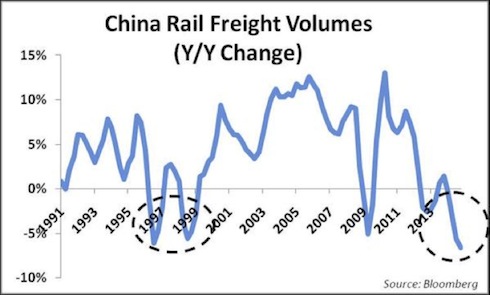
Of the three, rail freight volumes is the most significant as it is the hardest to fake. And according to China’s rail freight volumes, China’s economy is collapsing to levels on par with those last seen during the Asia Financial Crisis (h/t RBS Economics)

china rail.jpg

Rail traffic is not the only metric showing pronounced weakness. As ZeroHedge noted a few months ago, based on China’s electricity consumption is rolling over, suggesting a pace of growth closer to 3.5%.

20140815_china1_0.jpg

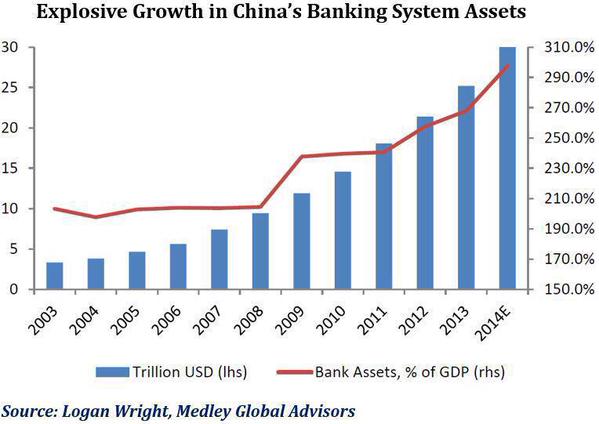
As for bank lending, we all know that China’s shadow banking system has expanded at pace beyond anything else in the world. Since 2008, China’s real economy is believed to have grown by $4 trillion. However, its banking assets have more than QUADRUPLED this, growing to nearly $17 trillion.

CC9WXIAVIAImeeP-1.jpg

Where does this leave China today?

With a weak economy that is at best growing at 3.5% and at worst in full-scale contraction… and a banking system that is leveraged beyond anything else in the world.

China was rife with bubbles in real estate and stocks. Indeed, by some measures, the China stock bubble was even more overvalued that the NASDAQ Tech Bubble of 1999!

And yet, 99% of investors believed that China’s economy is growing rapidly. These folks ignored one of the largest black swans in the system today.

And now they're being taken to the cleaners... ."

Graham Summers
Phoenix Capital Research

Thursday, July 2, 2015

“Private equity is selling everything that’s not bolted down. With the robust valuations in today’s market, they are accelerating monetizations of companies they own.”


"It’s clear that we are currently in an environment of frothy valuations,” said Lise Buyer, founder of IPO advisory firm Class V Group.
Her disturbing punchline: "The insiders - those with the most knowledge - are finding this a very good time to take some money off the table."
This year, private-equity firms sold $73 billion of their buyouts to the public, a record amount over a six month period, Bloomberg data show..."